
Everyone is rushing to hire “multi-agent AI” to run their workflows. You’ve probably seen the pitches: AI isn’t just a chat bot anymore; it’s a team of autonomous digital workers seamlessly handling your enterprise operations. It is the biggest tech trend of 2026, and for good reason. Gartner predicts that by 2028, at least 15% of day-to-day work decisions will be made autonomously by agentic AI, up from absolutely zero in 2024.
But there is a massive, expensive problem nobody wants to talk about in those shiny tech demos: Your new, highly advanced AI agents are ready to work, but your legacy servers are taking a nap.
You cannot run autonomous, 2026-grade multi-agent AI on infrastructure built for 2015 web traffic. Trying to run a decentralized, multi-agent AI system on a bloated monolithic server is like giving a hyper-intelligent octopus a single pair of chopsticks. It has the brains, it has the arms, but you’ve completely bottlenecked its ability to execute.
If you want the AI revolution, you need the cloud infrastructure to actually support it.
The “Virtual Team” Delusion
Let me paint a picture of a scenario we see almost weekly at Arthurite Integrated.
A company decides to deploy a virtual team of AI agents. They set up a brilliant “Project Manager Agent” to ingest client data, a “Developer Agent” to write the code, and a “QA Agent” to test it. They hit “Go.” For the first five minutes, it’s magic. The agents are chatting, routing tasks, and collaborating like a digital assembly line.
Then, reality hits the backend.
The API rate limits max out. The monolithic server, designed to handle linear human clicks, suddenly faces thousands of asynchronous requests per second from bots talking to other bots. The database locks up. The AI starts hallucinating because it can’t retrieve live web data fast enough. Finally, the whole system crashes, leaving the CTO staring at an exploding cloud compute bill.
The AI wasn’t the problem. The failure was treating an agentic AI deployment like a standard software update, rather than a fundamental shift in cloud architecture.
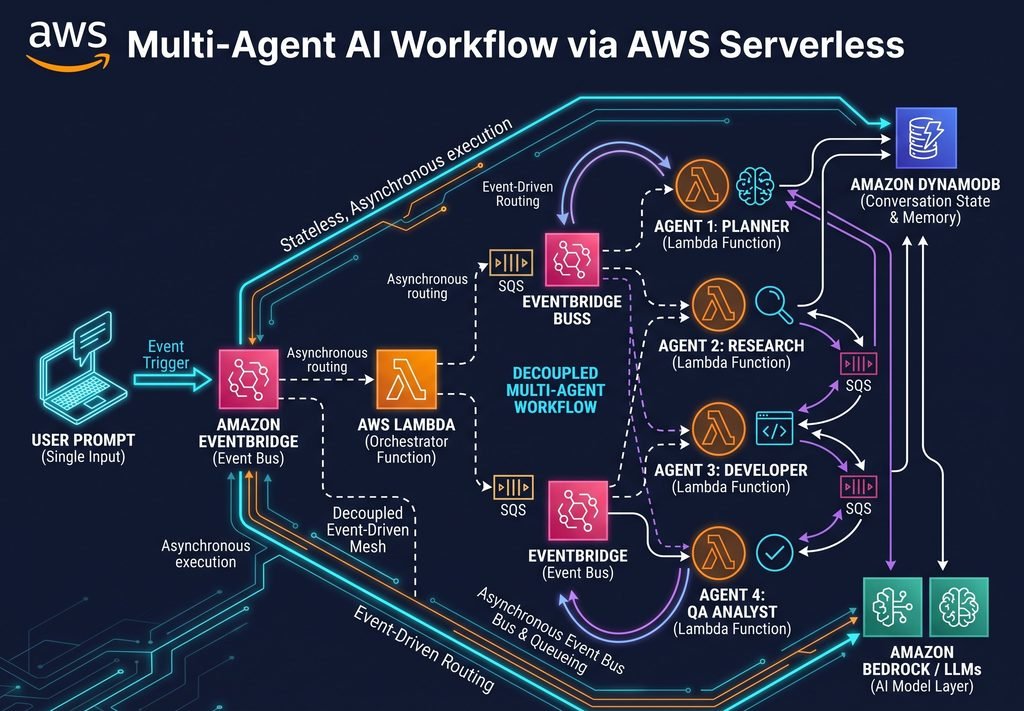
The Difference Between “Assistive” and “Agentic” Infrastructure
To understand why legacy cloud setups fail, you need to understand the critical difference in how AI operates today.
- Assistive AI: A human types a prompt, the AI generates a response, and the human takes the action. This is a 1:1 relationship. Legacy servers handle this fine because the human acts as the natural speed bump.
- Agentic (Multi-Agent) AI: A human sets a goal, and a network of AI agents takes over. They execute multi-step workflows, call out to external APIs, trigger databases, and run infinite background tasks without human intervention.
When AI agents go from demos into production, they require a backend that behaves like a reliable event fabric. They need infrastructure that can instantly scale from zero to ten thousand concurrent processes, route complex messaging protocols, and shut down the millisecond the task is over so you aren’t paying for idle time.
The AWS Serverless Fix: Rebuilding for AI
This is exactly where the rubber meets the road for us as an AWS Advanced Tier Partner. To make multi-agent systems work, you have to rip out the monolithic bottlenecks and replace them with a serverless architecture designed for asynchronous execution.
Here is what a true AI-native cloud backend looks like when we build it:
- AWS Lambda (The Muscle): Instead of a central server choking on concurrent agent requests, we decouple your agents using AWS Lambda. Every time an agent takes a step, a stateless, serverless function spins up, executes the logic, and vanishes. It’s infinite scale with zero idle cost.
- Amazon API Gateway (The Traffic Cop): When your agents need to communicate with external tools or each other, API Gateway ensures the traffic flows smoothly without crashing your core systems.
- Amazon DynamoDB (The Memory Bank): Multi-agent systems require persistent memory to maintain context across complex interactions. We leverage DynamoDB for single-digit millisecond latency so your AI agents instantly recall past actions without breaking a sweat.
When you migrate to a decoupled, serverless AWS framework, your infrastructure finally matches the speed of your AI.
It’s Time to Fire Your Legacy Stack
In 2026, competitive advantage isn’t just about having the smartest AI models; it’s about having the operational infrastructure to let those models actually run. You can keep buying the latest AI software, but until you fix the plumbing, you are just pouring expensive water into a leaky bucket.
At Arthurite Integrated, we specialize in the heavy lifting of cloud modernization. We don’t just migrate data; we completely re-architect your AWS environment so that it becomes the ultimate engine for your multi-agent AI systems.
Ready to let your AI agents actually do their jobs? Let’s talk about migrating your backend to a serverless reality.