
A promising conversation at an exhibition can last just a few minutes. Turning it into a business opportunity takes longer.
Someone has to capture the contact details, remember what the prospect needed, decide how urgently to respond, and make sure the follow-up actually happens. Meanwhile, the next visitor is already waiting.
That gap between a good conversation and a useful sales record is the problem Sufy App was built to address.
Developed by Arthurite Integrated, Sufy brings voice capture, AI-assisted lead extraction, and pipeline visibility into a single workflow—supported by an AWS serverless foundation.
When Notes Become a Follow-Up Problem
Sufy’s project brief identified three connected challenges: delayed transcription, missing priority context, and inconsistent follow-up.
For representatives working on a busy event floor, detailed data entry competes with the conversations they are there to have. For sales managers, incomplete notes make it harder to understand which opportunities deserve attention first.
The goal was to make capturing an interaction easier while giving the team a structured record it could act on.
That meant designing for two different experiences: a representative using a smartphone at an event, and a manager reviewing the resulting pipeline.
From Audio to a Structured Opportunity
Sufy supports audio uploads and structured form entries through a Next.js web application.
Its AI-assisted processing extracts details such as a prospect’s name, company, and area of interest, then assigns a high, medium, or low priority. Those records appear in a Kanban pipeline, giving the sales team a shared view of captured opportunities.
The requirements documentation records audio ingestion and AI extraction as implemented, with the pipeline interface and its refresh behaviour verified.
For the representative, the intended workflow reduces the need to reconstruct every interaction later. For the manager, it creates a clearer starting point for assigning attention and tracking progress.
Inside Sufy’s AWS Architecture
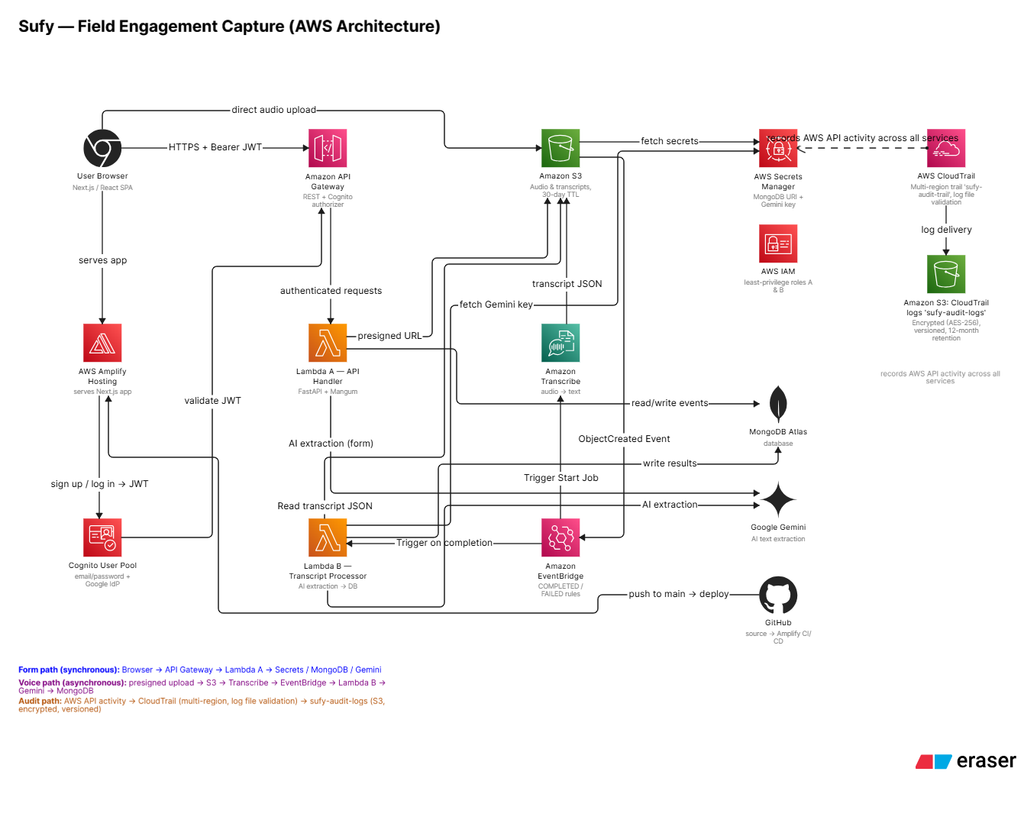
Sufy’s reference architecture connects event capture with authenticated APIs, asynchronous audio processing, AI extraction, and centralised lead storage.
AWS Amplify hosts the web application, with Amazon Cognito handling user authentication. Requests pass through Amazon API Gateway to Python AWS Lambda functions that perform backend processing.
Amazon S3 stores uploaded audio, while MongoDB Atlas stores lead records and application data. The supplied diagram illustrates an asynchronous voice-processing path using Amazon Transcribe, EventBridge, and a transcript-processing Lambda function, with Google Gemini extracting structured information.
The design also includes AWS Secrets Manager for integration credentials, IAM roles for service permissions, and AWS CloudTrail for AWS activity logging.
These components separate the user interface, processing, storage, and operational controls, allowing the team to develop and manage each part of the workflow more deliberately.
Giving Follow-Up a Deadline
Capturing a lead is only the beginning. Sufy’s next layer addresses what happens when a promising opportunity sits untouched.
The project defines a 24-hour follow-up rule for high-priority leads. An hourly EventBridge schedule triggers backend logic that checks for overdue records, with Amazon SES providing the email notification mechanism.
The delivery checklist marks the scheduled checks and overdue-lead logic as verified. Email configuration is established for sandbox testing, while production email access and final end-to-end sign-off remain outstanding.
That distinction matters: the accountability workflow has been built, but unrestricted production email delivery is still part of the remaining launch work.
Making Deployment Repeatable
Arthurite’s engineering work also focused on how the platform would be delivered and maintained.
AWS CDK defines the infrastructure in code, supporting repeatable deployment. GitHub integration triggers Amplify builds for the frontend, while the operational documentation establishes monitoring routines, incident troubleshooting, and escalation responsibilities.
The team also resolved authentication-related browser errors and verified the API’s handling of unauthorised requests. These changes support a more dependable experience when users sign in and retrieve their pipeline.
What Has Been Delivered
The project records confirm several completed milestones:
- Core AWS infrastructure deployed through AWS CDK.
- User authentication and API access controls verified.
- Frontend deployment connected to GitHub through Amplify.
- Audio ingestion and AI lead extraction implemented.
- Kanban pipeline functionality verified.
- Scheduled overdue-lead checks deployed and verified.
- CloudTrail audit logging established with protected log storage.
These are delivery milestones. Improvements in conversion, response time, or administrative effort will need to be measured as the platform moves through launch and adoption.
Building a Better Handoff From Conversation to Action
Sufy’s story starts with a familiar sales problem: useful conversations can lose momentum when the information around them is difficult to capture or follow up.
Its completed foundation brings capture, structured lead information, and pipeline visibility together. The remaining launch work focuses on completing the notification loop and production readiness.
The ambition is straightforward: help teams leave an event with opportunities they can act on, and a clearer process for acting on them.
Arthurite Integrated designs and builds cloud applications that connect business workflows with practical AI capabilities. Contact our team to explore how AWS and AI can support your next product.