
By Adekunle Kehinde (Web Engineer)
Executive Summary
Nigeria’s fintech ecosystem has experienced exponential growth over the past decade. From digital banks and payment gateways to switching companies and mobile money operators, technology has redefined how money moves across Africa’s largest economy.
However, rapid growth brings increased regulatory oversight. On June 15, 2026, the Central Bank of Nigeria (CBN) issued Circular PSS/DIR/PUB/CIR/001/004, introducing crucial market structure updates, ultimate beneficial ownership rules, and strict payment data localisation requirements.
Under the new directive, all regulated financial institutions and payment participants facilitating transactions in Nigeria must ensure that payment transaction data generated within Nigeria is stored and managed locally in accordance with applicable data protection laws. Covered entities have until January 1, 2027 to achieve full compliance.
For fintechs running core systems entirely in foreign cloud regions, this directive presents a critical strategic question: How do you maintain the scalability and agility of the cloud while satisfying strict local data residency mandates?
The answer lies in hybrid cloud architecture—and leveraging AWS’s expanding footprint in Nigeria alongside expert execution from Arthurite Integrated.
1. Understanding the CBN Mandate: What Actually Changed?
The CBN’s directive is part of a broader push toward system resilience, financial sector transparency, and data sovereignty.
The Core Requirement:
“All Financial Institutions and participants facilitating payments within Nigeria shall ensure that payment transaction data generated within Nigeria are stored and managed in Nigeria in accordance with data protection laws and regulations applicable in Nigeria.”
— CBN Circular PSS/DIR/PUB/CIR/001/004
Key Directives at a Glance:
- Scope: Reaches Deposit Money Banks, Microfinance Banks, Payment Service Banks, Mobile Money Operators, PTSPs, PSSPs, switching/processing entities, and super agents.
- Enforcement Deadline: January 1, 2027.
- Data Protection Alignment: Compliant architectures must strictly align with the Nigeria Data Protection Act 2023 (NDPA).
- Broader Governance: The circular also introduces Ultimate Beneficial Ownership (UBO) disclosures, systemic oversight measures, and market concentration caps.
For engineering and compliance teams, the six-and-a-half-month compliance window requires an immediate infrastructure review.
2. Why Data Localisation Is More Than “Moving the Database”
A common misconception is that compliance simply requires migrating a database to a local server. In modern, microservices-driven fintech applications, data is rarely confined to one place.
Consider a single payment flow: a customer initiates a transfer via a mobile app. The request passes through an API gateway, authentication microservices verify the user, the core payment engine processes the transaction, databases log the ledger, fraud detection tools analyze the activity, and telemetry platforms push events to data warehouses.
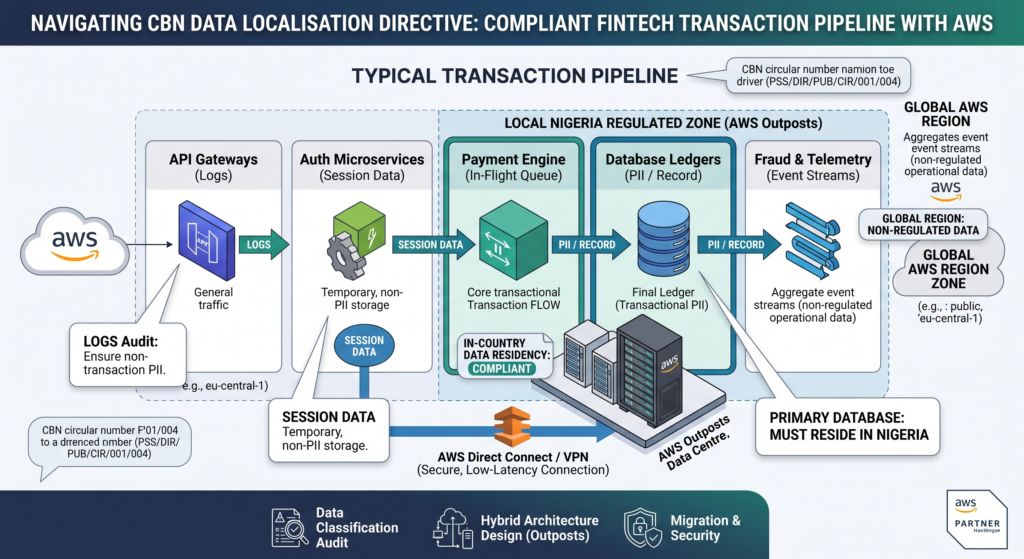
Payment transaction data exists across multiple lifecycle layers:
- Primary databases & ledgers
- Application and server logs
- In-flight message queues (e.g., Kafka, SQS)
- Database read replicas & backups
- Fraud detection systems & analytics engines
- Disaster recovery environments
Because of this interconnectedness, compliance cannot be treated as a quick database migration project. Teams must perform a holistic audit of the entire data lifecycle.
3. The Hybrid Cloud Solution: “Which Workloads Belong Where?”
Moving away from the cloud entirely is neither practical nor necessary. Modern cloud architecture is not a binary choice between “100% On-Premises” and “100% Overseas Public Cloud.”
Instead, progressive organizations adopt a hybrid cloud posture, asking: Which specific workloads require local deployment, and which can leverage global cloud regions?
Under a hybrid model, sensitive payment processing workloads and primary transaction databases reside on infrastructure located within Nigeria, while non-regulated services (such as global application modules, development pipelines, or aggregated non-PII analytics) can continue using global AWS regions.
AWS provides three primary building blocks that make this architecture possible in Nigeria:
4. AWS Building Blocks in Nigeria
A. AWS Outposts (Second-Generation Racks)
AWS Outposts extends native AWS infrastructure, services, APIs, and management tools directly into a customer’s physical data centre or local colocation facility.
AWS announced that second-generation AWS Outposts racks are available for installation in Nigeria. This allows fintechs to run local AWS compute, storage (EBS/S3 on Outposts), and managed database services (like Amazon RDS) inside approved Nigerian Tier III data centres—enabling full data residency while maintaining a unified AWS operational model.
B. AWS Local Zone (Lagos: af-south-1-los-1a)
AWS operates an AWS Local Zone in Lagos (af-south-1-los-1a), parented by the Africa (Cape Town) Region.
- Supported Local Services: Amazon EC2, Amazon EBS, Amazon VPC, Application Load Balancer (ALB), Amazon ECS, Amazon EKS, AWS Direct Connect, AWS Elastic Disaster Recovery, and Route 53.
- Important Nuance: A Local Zone is not a full AWS Region. Services like Amazon RDS or native S3 are not currently hosted directly within the Lagos Local Zone edge location. System architects must carefully verify service availability tables when designing production database layers.
C. AWS Direct Connect (Lagos Rack Centre)
Hybrid infrastructure demands low-latency, secure connectivity. AWS maintains an AWS Direct Connect location at the Rack Centre data centre in Lagos, supporting dedicated 10 Gbps and 100 Gbps private connections with MACsec encryption. This allows fintechs to bypass the public internet when linking local environments to AWS regional resources.
5. Architectural Comparison for Nigerian Fintechs
To evaluate options before the January 1, 2027 deadline, engineering teams can reference this architectural matrix:
| Architectural Approach | Data Residency Compliance | Low-Latency Local Processing | AWS Managed Service Access | Migration & Operational Effort |
| Pure Overseas AWS Region | ❌ Non-Compliant for local transaction data | ⚠️ Moderate (Cross-border network latency) | Full native AWS catalog | Low (Current state for many) |
| Traditional Local On-Premises | ✅ Fully Compliant | ✅ Ultra-Low Latency | ❌ Lost access to AWS tools & automation | High (Requires complete re-architecting) |
| AWS Outposts (Hybrid) | ✅ Fully Compliant (Physical servers in Nigeria) | ✅ Ultra-Low Latency | ✅ Native AWS APIs, RDS, EKS, EBS local | Medium (Sustains current AWS workflows) |
| AWS Local Zone (Lagos) | ⚠️ Compliant for compute/containers (Check database hosting) | ✅ Ultra-Low Latency | ⚠️ Subset of AWS services (af-south-1-los-1a) | Low to Medium |
6. Critical Engineering Considerations: Beyond Hosting
Localizing data does not automatically satisfy regulatory or operational demands. Architectures must be engineered around three core pillars:
1. Data Classification & Flow Mapping
Before deploying hardware or moving databases, organizations must categorize data into Regulated Payment Data (must stay in Nigeria) vs. Non-Regulated Operational Data (can leverage global regions).
2. High Availability & Disaster Recovery (DR)
Localizing data increases the importance of robust DR planning.
- Where are disaster recovery backups stored?
- Does the failover site also satisfy Nigerian data residency rules?
- What is the Recovery Time Objective (RTO) and Recovery Point Objective (RPO) during local utility or connectivity disruptions?
3. Security & Governance Baseline
Moving workloads locally does not remove the threat of misconfigurations, insider risks, or ransomware. Compliant environments must integrate end-to-end encryption (at rest and in transit), IAM role granularity, centralized logging (AWS CloudTrail/CloudWatch), and local security monitoring.
💡 Compliance Note: AWS Outposts and Local Zones are enabling technologies, not automatic compliance tools. Achieving full compliance depends on exact workload design, access controls, network segmentation, and regulatory interpretation.
7. How Arthurite Integrated Solves the Compliance Challenge
Navigating data classification, hybrid networking, hardware provisioning, and zero-downtime database replication under a tight regulatory deadline requires specialised expertise.
As an AWS Advanced Tier Partner in Nigeria, Arthurite Integrated helps fintechs and financial institutions design, deploy, and manage fully compliant hybrid cloud environments.
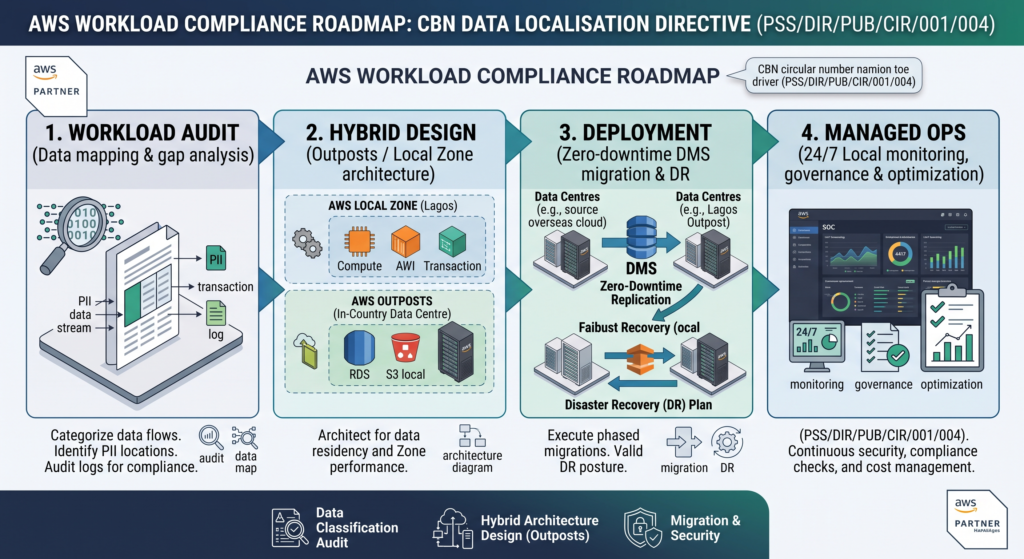
Our Core Services:
- Architecture & Compliance Audits: Comprehensive analysis of existing application data flows, database dependencies, logging mechanisms, and third-party integrations to identify non-compliant data paths.
- AWS Hybrid Cloud Design: Tailored architecture leveraging AWS Outposts, AWS Local Zones, and AWS Direct Connect to ensure regulated payment data remains strictly within Nigerian borders without sacrificing cloud scalability.
- Seamless Migration Execution: Executing phased data migration strategies using tools like AWS Database Migration Service (DMS) to ensure continuous processing uptime.
- Resiliency & DR Design: Building multi-site, compliant disaster recovery strategies designed specifically for Nigerian infrastructure realities.
- 24/7 Managed Cloud Services: Local, Nigerian-based AWS-certified engineers providing ongoing monitoring, security management, cost optimization, and operational support.
Conclusion & Next Steps
The Central Bank of Nigeria’s data localisation directive is more than an infrastructure requirement—it marks a permanent shift toward digital data sovereignty in African financial services.
Cloud innovation and regulatory compliance are not mutually exclusive. By leveraging AWS’s hybrid infrastructure—including Outposts, Local Zones, and Direct Connect—alongside the local implementation expertise of Arthurite Integrated, fintechs can build a compliant, secure, and ultra-low-latency foundation for the future.
With the January 1, 2027 deadline approaching, early assessment is essential to ensure ample time for architecture design, testing, migration, and validation.
Ready to Align Your Cloud Architecture with CBN Directives?
Speak with our certified AWS cloud solutions architects at Arthurite Integrated to schedule your CBN Compliance & Infrastructure Readiness Audit today.