
By: Dauda Lawal – Web Developer
Modern cloud applications require infrastructure that is scalable, reliable, and easy to manage. On Amazon Web Services (AWS), two services that frequently appear in application deployment discussions are Amazon Elastic Container Service (Amazon ECS) and Amazon Elastic Compute Cloud (Amazon EC2).
Although they serve different purposes, these services can work together to help businesses deploy and manage applications efficiently.
What Is Amazon EC2?
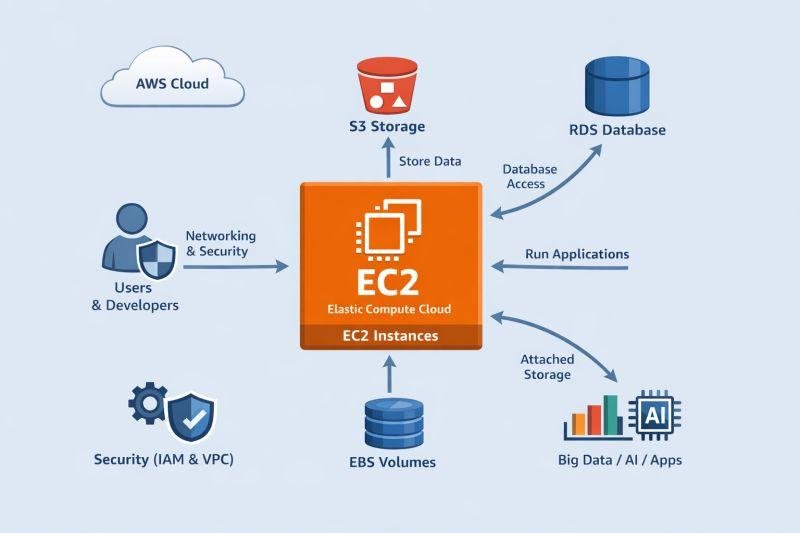
Amazon EC2 is an AWS service that provides resizable virtual servers in the cloud. It allows businesses to launch computing instances with different operating systems, processor configurations, memory capacities, and storage options.
With EC2, developers have control over the underlying server environment. They can install software, configure networking, manage operating systems, and run applications based on their requirements.
Common use cases include:
- Hosting websites and web applications.
- Running databases and backend services.
- Supporting development and testing environments.
- Running enterprise applications.
- Hosting workloads that require specific server configurations.
EC2 gives organizations flexibility and control over their computing infrastructure without requiring them to purchase and maintain physical servers.
What Is Amazon ECS?
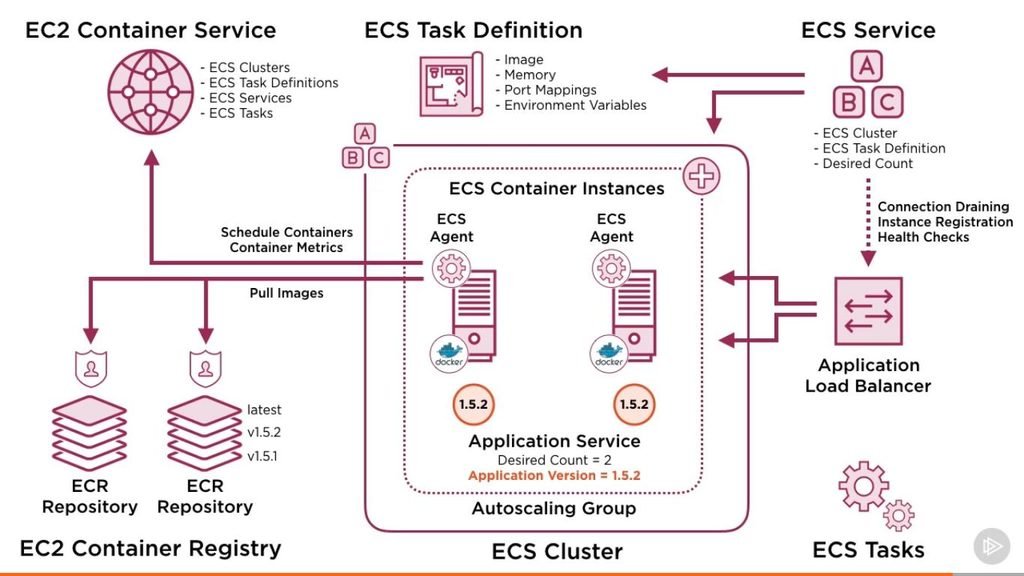
Amazon Elastic Container Service (Amazon ECS) is a fully managed container orchestration service that helps developers deploy, manage, and scale containerized applications.
Rather than manually managing individual application containers, ECS coordinates how containers run across available computing resources.
ECS uses important components such as:
- Clusters: Logical groupings of infrastructure used to run container workloads.
- Task Definitions: Blueprints that describe how containers should run, including images, CPU, memory, and networking settings.
- Tasks: Running instances of task definitions.
- Services: Maintain the desired number of running tasks and support application deployment and availability.
ECS simplifies container management, making it easier to operate applications packaged with technologies such as Docker.
How Amazon ECS and Amazon EC2 Work Together
One important thing to understand is that Amazon ECS and Amazon EC2 are not necessarily competing services. They can work together.
When using the ECS EC2 launch type, EC2 instances provide the underlying computing capacity, while ECS manages the container workloads running on that infrastructure.
For example, a business could deploy a web application using Docker containers. ECS schedules and manages those containers, while EC2 instances provide the CPU, memory, and infrastructure required to run them.
This architecture gives organizations control over their server resources while benefiting from ECS container orchestration.
ECS also supports AWS Fargate, which allows businesses to run containers without provisioning or managing EC2 instances directly.
Amazon ECS vs Amazon EC2: Which Should You Use?
The right choice depends on the application architecture and operational requirements.
| Requirement | Amazon EC2 | Amazon ECS |
|---|---|---|
| Primary purpose | Virtual computing | Container orchestration |
| Infrastructure control | High | Depends on launch type |
| Container management | Manual or through other tools | Built-in orchestration |
| Scaling | Instance-level scaling | Container task and service scaling |
| Best suited for | Traditional server workloads | Containerized applications |
For applications that require direct server control, EC2 is a strong option. For businesses adopting container-based architectures, ECS provides tools to manage deployments, scaling, and container operations.
Organizations can also combine both services to build flexible cloud environments.
Final Thoughts
Amazon ECS and Amazon EC2 play different but complementary roles in AWS cloud architecture. EC2 provides computing infrastructure, while ECS simplifies the deployment and management of containerized applications.
Understanding how these services work individually and together helps businesses make better infrastructure decisions, improve application deployment, and build scalable cloud solutions.
At Arthurite Integrated, we help businesses explore AWS infrastructure, cloud-native application development, and scalable deployment strategies that support their technology goals.