
Customer Reference
How a regional financial institution deployed Spark — an AI-powered conversational banking solution on AWS — to serve underbanked populations, slash operational costs, and establish digital leadership in its market.
| 70% | Reduction in customer service response time |
| 45% | Reduction in call centre operational costs |
| 60% | Increase in customer engagement |
| 99.5% | System availability during business hours |
This case study has been anonymised at the client’s request. Industry, market context, and all performance metrics are presented accurately.
About the Client: A Regional Bank With a Mission Beyond Banking
This regional financial services institution serves a diverse customer base that includes a significant proportion of underbanked populations — people who have historically faced barriers to mainstream financial services due to digital literacy constraints, limited smartphone access, or unfamiliarity with traditional banking interfaces.
The institution’s mission is not merely to provide banking services, but to democratise access to them — making financial tools available to communities that larger banks have systematically underserved. This mission made the implementation of Spark not just a technology project, but a social impact initiative with measurable consequences for financial inclusion.
The Challenge: When Traditional Banking Infrastructure Becomes a Barrier
Despite its progressive mission, the institution’s service delivery model was built on infrastructure that worked against it. Manual, agent-dependent operations, business-hours-only support, and a mobile application that required levels of digital literacy many customers simply did not have — these constraints were turning away the very people the bank existed to serve.
- Heavy manual intervention dependency creating capacity constraints and scalability ceilings
- High call centre operating costs from staffing for routine, repetitive customer requests
- Extended queue-based wait times negatively impacting satisfaction and retention
- Mobile app complexity excluding customers with limited digital literacy
- App fatigue from multiple banking applications across different institutions
- Business-hours-only support restricting access for working populations
- Inability to scale reach into underserved markets without proportional cost increases
“The technology meant to bring people closer to banking was, in practice, keeping them out.”
The Solution: Spark — AI-Powered Banking Through WhatsApp
Arthurite Integrated designed and deployed Spark, a production-grade generative AI banking assistant that meets customers exactly where they already are: WhatsApp. With over two billion active users globally and deeply embedded in the daily communication patterns of the institution’s target market, WhatsApp eliminated the app-download barrier entirely.
Conversational Banking in Natural Language
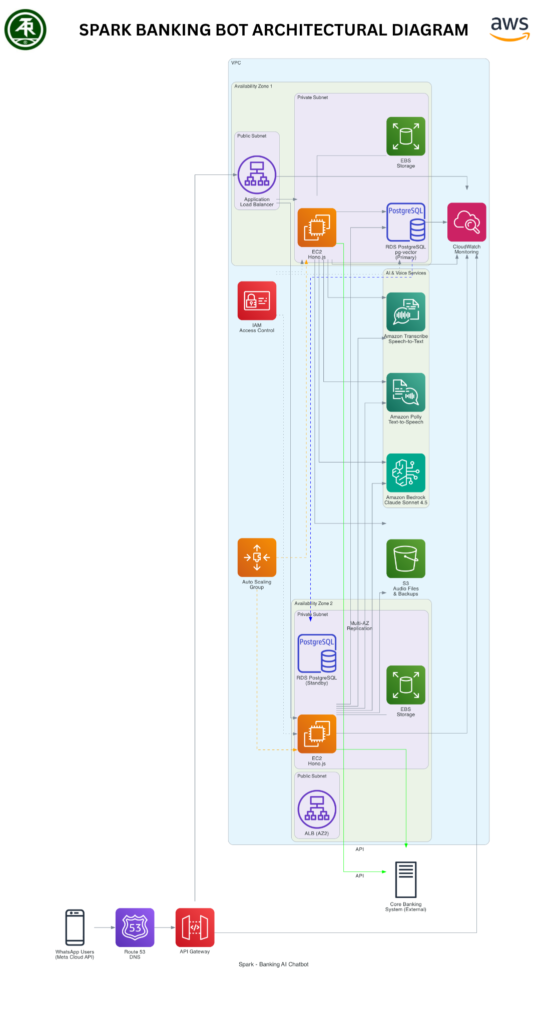
Powered by Amazon Bedrock with Claude Sonnet 4.6, Spark understands and responds to customer banking queries in natural conversational language — handling account balance enquiries, transaction history, payment initiations, product information, and service requests without requiring customers to navigate menus, learn commands, or interact with a traditional interface.
Voice-Enabled for Low-Literacy Customers
Amazon Transcribe and Amazon Polly give Spark voice capabilities — customers who find text-based interaction challenging can speak their queries and receive spoken responses. This was a direct design response to the institution’s financial inclusion mandate, removing one of the most persistent barriers to banking access for underbanked populations.
Contextual Memory and Personalisation
Amazon RDS with pg-vector powers Spark’s contextual memory — the system remembers previous interactions and maintains conversational continuity, creating a banking experience that feels personalised and coherent rather than transactional and repetitive. A customer does not need to re-explain their situation every time they interact.
The Technology: Built for Security, Scale, and Accessibility
- Amazon Bedrock (Claude Sonnet 4.6)
- Amazon Transcribe
- Amazon Polly
- Amazon RDS + pg-vector
- Amazon EC2 Auto Scaling
- Amazon API Gateway
- Amazon S3
- AWS WAF
- Amazon Route 53
- Amazon CloudWatch
- AWS VPC
- WhatsApp (Meta Cloud API)
The AWS VPC architecture ensures all customer banking data is processed within a secure, isolated network environment. IAM-based access controls enforce least-privilege principles at every service boundary. Data at rest and in transit is encrypted throughout. AWS WAF provides application-layer protection against injection attacks and abuse patterns.
The Results: First-Quarter Outcomes That Redefined the Business Case
| 70% | Reduction in response time through autonomous resolution of common inquiries |
| 45% | Reduction in call centre costs from decreased staffing requirements for routine interactions |
| 60% | Increase in customer engagement driven by 24/7 conversational and voice-enabled capabilities |
| 30% | Decrease in cost per transaction improving financial efficiency |
| 90% | AI intent recognition accuracy ensuring reliable service automation |
| 85% | Transaction success rate demonstrating robust end-to-end workflow automation |
The sub-2-second average API response time kept the interaction feeling immediate and human. The 99.5% system availability during business hours exceeded contractual service level commitments.
Strategic Impact: Beyond the Metrics — Financial Inclusion at Scale
The most significant outcome of Spark’s deployment cannot be captured in an operational metric. By eliminating the technical barriers that had previously excluded significant portions of the institution’s target market, Spark enabled banking access for people who, under the previous model, simply could not engage.
The institution is now positioned as a digital banking innovator within its regional market — not because it adopted AI for efficiency’s sake, but because it used AI in service of its core mission: making banking genuinely accessible to everyone who needs it.
The cloud-native, serverless-adjacent architecture ensures that expanding to additional markets and products requires no proportional increase in operational costs — Spark scales to serve more customers without breaking the economics that make financial inclusion viable.