Success Outpacing the System Behind It
Oldnavi’s booking and dispatch platform was serving somewhere between 350,000 and 500,000 customers. Behind that scale, dispatch still ran on spreadsheets, phone calls, and WhatsApp groups. The cost was measurable:
- 10% of bookings were rescheduled because of dispatch coordination errors across roughly 90 daily jobs, costing $32,000 a year in lost revenue.
- 30 hours a week of manual dispatch oversight across 1.5 full-time staff added up to $85,800 a year in administrative overhead.
- Fragmented third-party tools added another $42,000 a year, putting the total baseline operating cost at $159,800 a year.
With the business targeting 18% annual growth, from 90 to more than 200 jobs a day, scaling that model would have meant more headcount and compounding error losses. Oldnavi also wanted real intelligence in the customer and operations experience, built into the platform from the start.
Rebuilding for Scale, With Intelligence Built In From Day One
Oldnavi brought in Arthurite Integrated for a full migration and modernization engagement with four goals: move critical workloads to AWS, modernize for scalability and resilience, build for tomorrow’s volume, and make AI-enabled capabilities a core part of the platform.
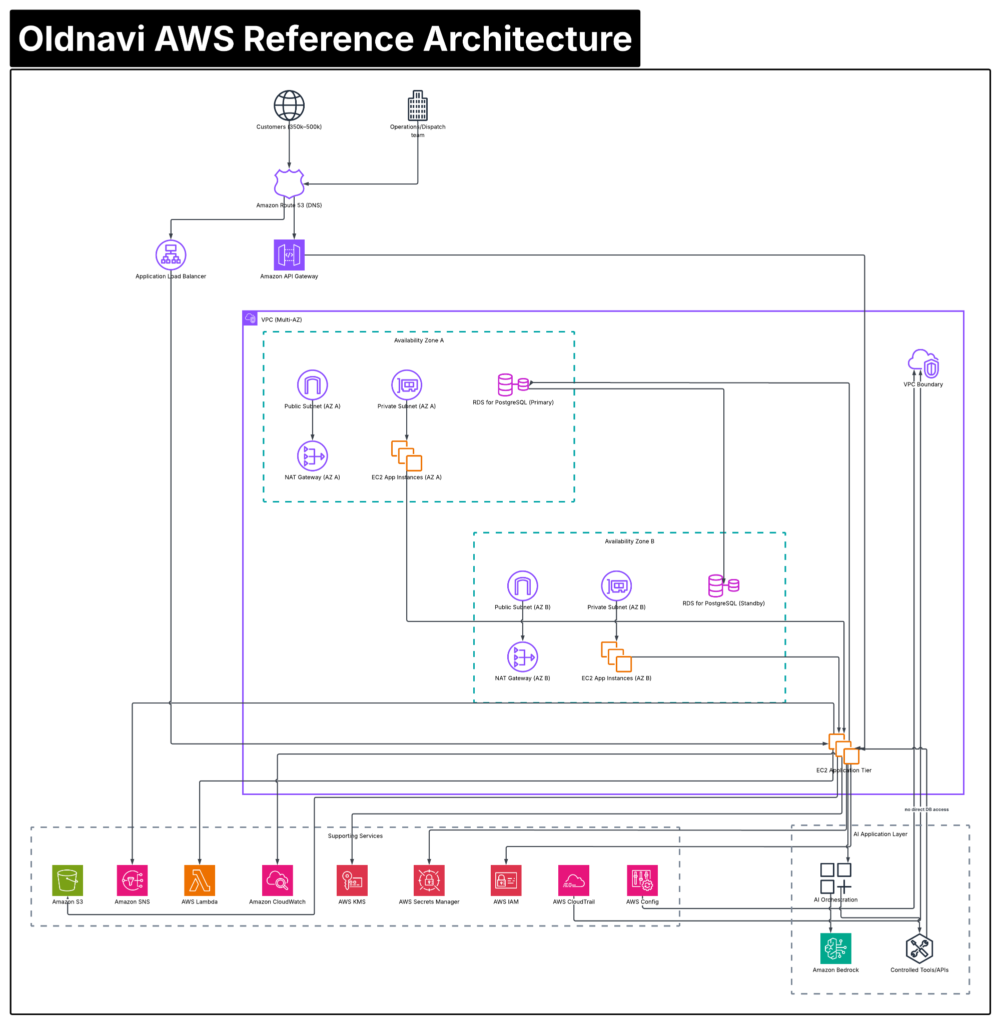
The architecture deliberately avoids a serverless-only approach. Amazon EC2, running in a highly available, multi-Availability-Zone VPC, gives a high-volume transactional platform control and predictability. It is backed by Amazon RDS for PostgreSQL in Multi-AZ, Amazon API Gateway for managed API access, and a security and monitoring stack of CloudWatch, KMS, Secrets Manager, IAM, CloudTrail, and Config.
A dedicated AI orchestration layer sits deliberately apart from the production database. Every AI-driven action is routed through controlled, authorized application APIs rather than direct data access.
Amazon Bedrock powers agentic booking assistance. A customer describes what they need, the AI interprets the request, checks real availability through the platform’s authorized APIs, and completes the booking without ever touching the production database directly.
What Changed: Metrics for Success
The modernized platform has been live in production since November 2025. Arthurite agreed baselines and targets with Oldnavi before delivery began, then measured results against them through a Day-90 value realization review.
KPI 1: Booking rescheduling error rate
| Baseline | 10% (about $32,000/year in lost revenue) |
| Target | Below 1% within 90 days of cutover |
| Result | 0.0%, recovering the full $32,000/year |
| How it was measured | Monthly ratio of coordination-error reschedules and cancellations to total completed bookings, validated against production database audit logs |
KPI 2: Administrative dispatch labor
| Baseline | 30 hours/week, $85,800/year |
| Target | At least a 50% reduction (15 hours/week or less) |
| Result | 13.7 hours/week, a 54.5% reduction, saving $46,800/year |
| How it was measured | Weekly time-tracking audits of dispatch staff, plus Amazon CloudWatch telemetry from API Gateway and Amazon Bedrock |
Supporting results
- Dispatch latency fell from several minutes to under 2 seconds.
- Availability held at 99.9% or better through morning peaks of 500 to 2,000 requests per second.
- Amazon Bedrock handled 59,233 successful booking invocations in the first 90 days, with no prompt-injection breaches and no database permission errors.
- Daily volume grew from 90 to 200+ jobs with no added administrative headcount.
- Customer satisfaction scored 4.97 out of 5 at the Day-90 review.
Business impact. Net annual benefit is $115,100: $46,800 in labor savings, $32,000 in recovered booking revenue, and $42,000 in retired tooling, less $5,700 in AWS run cost. Against a $6,000 migration investment, that is a 3-year ROI of 5,655% and payback in under 30 days.
The platform also has AI-specific validation built into its launch process. Guardrail checks and tool authorization were signed off with the same weight as core technical and business criteria. A CI/CD pipeline with automated testing, release approval, and rollback was in place from day one.
Infrastructure That Won’t Need Outgrowing Again
Oldnavi no longer has to choose between growing the business and trusting the platform underneath it. With infrastructure-as-code, automated deployment, and an AI layer designed for controlled expansion, the foundation can take on dispatch optimization, predictive demand forecasting, and deeper AI-driven recommendations without another ground-up rebuild.
“We didn’t want AI bolted on as a gimmick. We wanted it built into the platform the same way the database and the load balancer are, as core infrastructure. That’s exactly what we got,” says the Technology Lead at Oldnavi.
Oldnavi’s platform was designed and delivered by Arthurite Integrated on AWS. To learn how a modernized, AI-enabled AWS architecture could help your business scale with confidence, get in touch.